Sherpa Profiles
Microsoft
Sherpa Profiles 01 · October 2026
Every company Microsoft does business with on infrastructure deals — named, with how often, in what role, and what else they do.
- Type
- Profile
- Extent
- 104 pages
- Published
- October 2026
- Geography
- Global
- Publisher
- Global Infrastructure Sherpa / Sherpa Publishing
- Price
- $495 — single-user licence
Overview
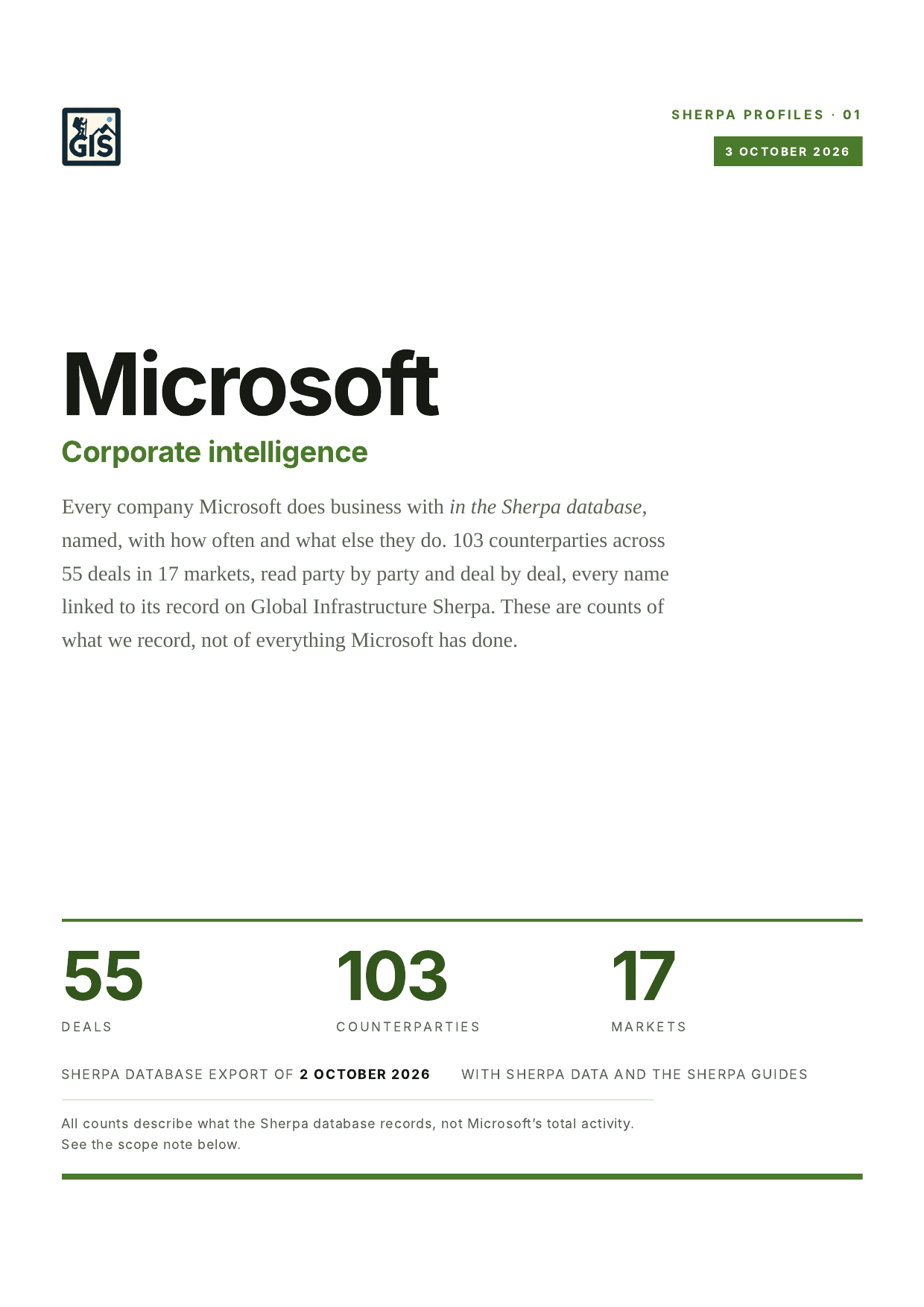
Who Microsoft actually does business with on power, data centres, gas, land and carbon — every counterparty named on a Microsoft deal in the Sherpa record, with how often, in what role, and what else they do.
The profile reads 55 deals and 103 counterparties across 17 markets, party by party and deal by deal: the role Microsoft takes on each deal, the deal register with each record’s own description, parties and source, a KYC file on each counterparty, the shared supply base with Google, Meta, Amazon and Apple, who comes back for a second deal, what is disclosed and what is not, and the network to three degrees.
Every count describes what the Sherpa record holds, not Microsoft’s total activity. Not investment advice.
What this edition covers
Eighteen sections: a summary; every company Microsoft does business with, sorted by type; what kind of counterparty Microsoft is; the network to three degrees and who opens it; the network around the deals; a KYC file on each of the 103 counterparties; the shared supply base with other hyperscalers; incumbency; disclosed value; gas; land and development; carbon and hydrogen; shared platforms; lenders; measurement against Microsoft’s own stated figures; entities held under more than one name; and the contract layer.
Who this is for
Developers, IPPs and utilities pitching Microsoft; lenders and investors financing projects with a Microsoft offtake; advisers and data-centre suppliers mapping who already sells to it; and anyone running counterparty due diligence on Microsoft’s infrastructure supply chain.
What you get
- All 55 Microsoft deals in the record, each with its description, parties and source
- A KYC file on each of the 103 counterparties
- Every counterparty sorted by type: developers, funds, utilities, development finance, banks, data centre operators
- Which counterparties also appear on Google, Meta, Amazon or Apple deals
- Who comes back for a second deal — and who never does
- Microsoft’s stated capacity set against what can be traced deal by deal
- The network to three degrees, and who bridges out of it
- Every name linked to its record on Global Infrastructure Sherpa
Table of contents
- 01 — Summary: Microsoft is an offtaker on 39 of its 55 deals in our database; what it is on the other 16
- 02 — Who Microsoft does business with: Every company Microsoft has transacted with, named and sorted by what it is
- 03 — What kind of counterparty: Microsoft buys power, and it also buys land, carbon, gas and data centre capacity
- 04–05 — The network and who opens it: The network to three degrees, and the companies that bridge out of Microsoft’s first degree
- 06 — The network around the deals: 103 companies around 55 deals, holding 105 roles between them
- 07 — Counterparty KYC: A file on each of the 103 companies in the record
- 08–09 — Shared supply base and incumbency: Which counterparties also sell to Google, Meta, Amazon or Apple, and which come back for a second deal
- 10 — Disclosed value: The eleven numbers in the record, and why none of them is a price for electricity
- 11–14 — Gas, land, carbon and shared platforms: Chevron gas agreements, land and development, carbon removal, and deals shared with other hyperscalers
- 15–16 — Lenders and measurement: Who financed the sellers, and Microsoft’s stated 40 GW against what can be traced deal by deal
- 17–18 — Our own record and the contract layer: Entities held under more than one name, and Microsoft’s place among North American corporate power buyers
Research and sources
Built from the Sherpa database export of 2 October 2026. Each deal carries its own source. Counts describe what the record holds, not Microsoft’s total activity.
Licensing
Single-user licence. For use by the named licensee only. Redistribution, resale, posting to shared drives or internal circulation beyond the named licensee is a breach of licence.